
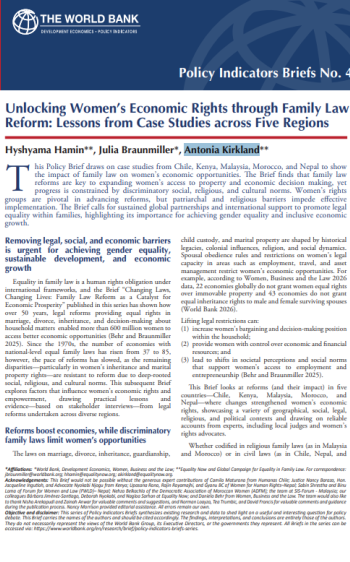
Unlocking Women’s Economic Rights through Family Law Reform: Lessons from Case Studies across Five Regions (document, English)
Topics
Country
Tags
Summary
This policy brief examines how family laws governing marriage, divorce, inheritance, custody, and marital property affect women’s economic opportunities. Drawing on case studies from Chile, Kenya, Malaysia, Morocco, and Nepal, the Brief demonstrates that legal reforms can expand women’s access to assets, strengthen their decision-making power, and improve economic security.
The brief finds that while significant progress has been made toward legal equality, discriminatory laws and deeply rooted social, religious, and cultural norms continue to limit women’s rights in many contexts. Women’s rights organizations play a critical role in advancing reform through advocacy, litigation, and public engagement, but challenges often remain in implementation and enforcement.
The authors conclude that family law reform is a key component of gender equality and inclusive economic growth. They call for stronger partnerships, equal legal protections regardless of religion or culture, and greater investment in implementation to ensure women can fully exercise their economic rights.
Source: The World Bank (Document Source)